
Fuel Cell Test Bench for Research: A Flexible Testing Solution for Hydrogen Technology
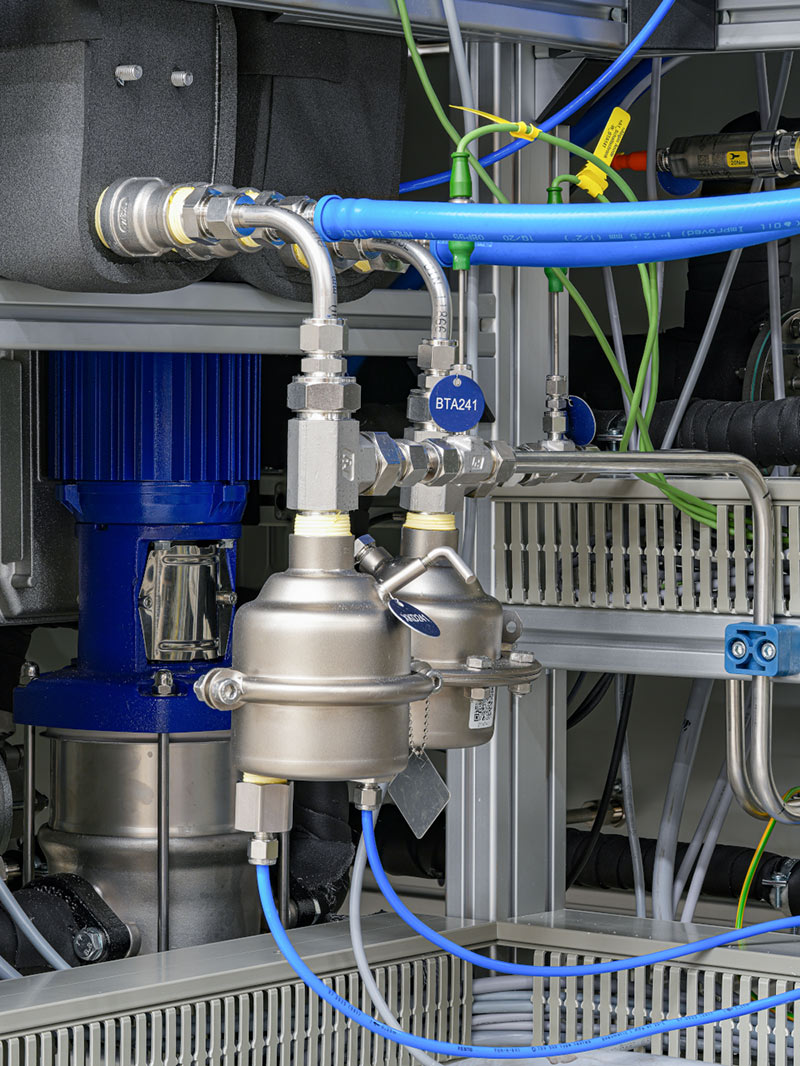
Hydrogen is considered one of the key energy sources for the energy transition, and intensive research and development is underway, particularly in Germany. On behalf of the Technical University of Braunschweig, BRIGHT has developed a fuel cell test bench that enables testing under controlled conditions. Together with its partner, TIRRON GmbH, the team worked actively on the project for about nine months, and the system is now set to be commissioned on site.
The technical requirements for the test bench are complex: Fuel cells are supplied with hydrogen and humidified air, and temperatures, pressures, and humidity levels must be precisely adjustable. Humidifying the process gases is a technical necessity: The membrane in the fuel cell, through which electrons are transported, operates reliably only when there is sufficient humidity. “Using the control software developed by Tiron, the customer can freely configure parameters, run pressure ramps, and test safety chains,” explains Project Manager Philipp Riexinger, emphasizing the safety aspect: “The system is designed to be pressure-resistant, as the controlled reaction of hydrogen and oxygen is a fundamental part of the test operation.”

BRIGHT was awarded the contract through a public bidding process. Another factor that contributed to the award was an existing sister test bench at the Technical University of Braunschweig, which had already established confidence in both partners’ implementation capabilities.
Because research institutes often do not yet know exactly which research questions they will be addressing at the time the project is commissioned, test benches do not need to be optimized for a fixed operating point but must be designed for a wide operating range. Whether the focus will be on degradation behavior, short-term tests, or shutdown processes usually becomes clear only during commissioning. “In any case, we’re well-equipped and prepared for anything,” says Riexinger.
The system was therefore specifically designed to meet the needs of research institutions that require a wide range of test scenarios. “Institutes often need flexible solutions because research goals evolve dynamically,” said Philipp Riexinger.

The project was carried out in close collaboration with our partner, TIRRON GmbH, which contributed, in particular, control and safety concepts. The system is currently still in the project phase: Following delivery, on-site commissioning will now take place, during which the test bench will be tested with actual test specimens and integrated into operations.
With this project, BRIGHT is strengthening its expertise in the field of highly flexible test bench solutions and contributing to the further development of sustainable energy and hydrogen technologies.