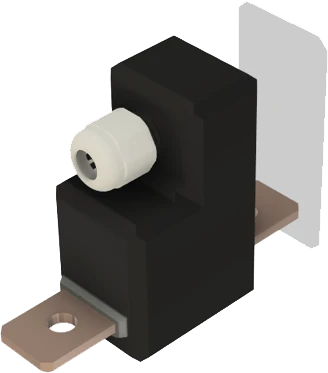
-
1 mA
Resolution
-
±750 A
Peak current
-
±225 A
Continuous current
-
±60 V
Voltage
Sleep Current Measurement in Vehicles – Resolved to 1 mA
The most reliable way to measure sleep current (also called quiescent current or parasitic draw) in a vehicle is a permanently installed shunt sensor that logs for hours or days. The PowerTrace HCS 75060 resolves currents down to 1 mA and sends the readings directly to CAN.
Sleep current is the current a vehicle draws from the battery when the engine is off and the vehicle is locked. Modern vehicles have a fixed sleep current budget in the milliamp range. If it is exceeded, the battery is drained after a few days of standstill.
Typical measurement tasks in development:
 Check ECU sleep behaviour after switch-off (ECU run-on)
- Find unwanted wake-up events in the electrical system
- Identify loads that drain the battery
- Verify the sleep current budget for each vehicle variant and trim level
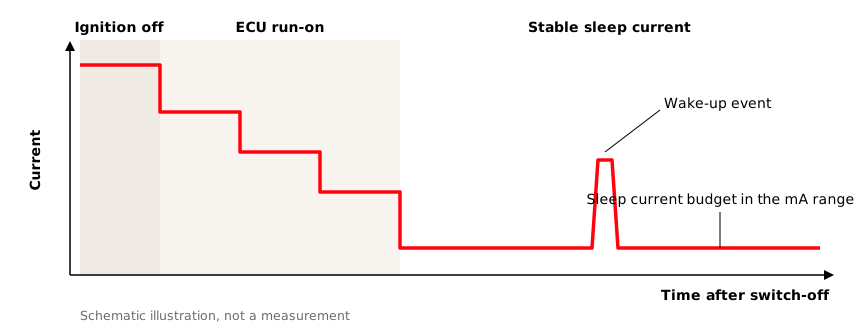
Why multimeters and current clamps reach their limits: Disconnecting the battery to insert a meter wakes up many ECUs, and the measurement has to start again. Current clamps often cannot resolve small currents finely enough and are not designed for permanent installation. A permanently installed shunt measures without interruption, even over several days.
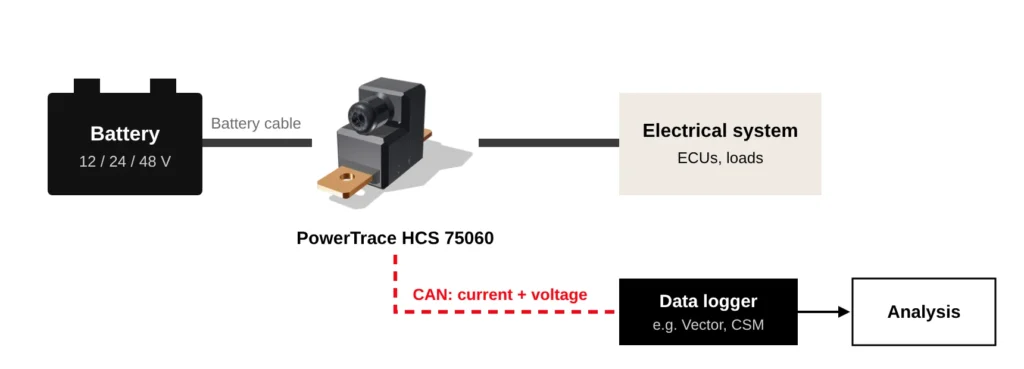
What the setup with PowerTrace looks like: The sensor is installed once in the battery cable and stays there. Current and voltage flow via CAN into your existing data logger, for example from Vector or CSM. Because the same sensor also measures ±750 A, you can record the engine start right afterwards without changing the setup.
Cranking Current and Starter Current Measurement – Even at −40 °C Cold Start
The PowerTrace HCS 75060 measures cranking current (starter current) up to ±750 A peak and ±225 A continuous, at a sampling rate of up to 1 kHz. At the same time, it records the voltage drop in the electrical system up to ±60 V.
When the engine starts, the starter motor briefly draws the highest current in the entire low-voltage system. In cold conditions this starter current rises significantly, because the oil is thicker and the battery is weaker. Measuring cranking current shows whether battery, cables and fuses are sufficient for a cold start.
Typical measurement tasks:
- Cranking current and voltage drop during cold starts in winter testing down to −40 °C
- Load peaks when start-stop systems restart the engine
- Fusing and cable sizing in 12, 24 and 48 V systems
- Starter current in endurance testing over many start cycles
Built for vehicle testing: The IP67 housing and the temperature range of −40 to +85 °C allow permanent installation in test vehicles, including climatic chambers and winter tests.
Limit: Very heavy commercial and special vehicles can draw more than 750 A during a cold start. Talk to us and we will check your measurement task in advance.
Sleep Current and Cranking Current at the Same Measuring Point – One Sensor Instead of Two
Measuring both sleep current and cranking current usually requires two sensors or two measuring ranges. PowerTrace measures both at the same point, with no rebuild and no range switching.
For current sensors, a large measuring range for load peaks usually comes at the cost of resolution, so small currents in the milliamp range become invisible. The PowerTrace HCS 75060 resolves this conflict: it combines a fine current range with 1 mA resolution and a measuring range up to ±750 A in one device.
What this means for your test fleet:
160sensors with two sensors per measuring point (20 vehicles × 4 measuring points)80sensors with PowerTrace, plus less cabling, fewer logger channels and shorter installation time
Fits existing measurement chains: PowerTrace sends directly on CAN and can be integrated into Vector, CSM and other data loggers. No system change is needed.
Benefits at a glance
- Wide dynamic range: fine resolution down to 1 mA and peak currents up to ±750 A in one sensor
- Robust IP67 housing for harsh environments
- Flexible CAN configuration, sampling rate up to 1 kHz
- Compact design (approx. 30 × 44 × 85 mm) for easy integration in tight spaces
- Continuous current up to ±225 A
- Precise: ±0.5 to 1 % in the continuous current range
- Software can be customised to your measurement task
- Wide temperature range: −40 °C to +85 °C
Where PowerTrace Is Used
PowerTrace is designed for development, testing and test benches in low-voltage vehicle electrical systems up to ±60 V.
- Electrical system development and energy management: Verify sleep current budgets, record ECU load profiles, check fusing.
- Test fleets and endurance testing: Permanently installed, IP67, readings via CAN into the vehicle logger, from sleep current to cranking current.
- Winter and cold-climate testing: Measure starter current and voltage drop during cold starts down to −40 °C.
- 48 V mild hybrids and start-stop: Load peaks and restarts in 48 V and 12 V systems.
- Commercial, special and public-authority vehicles: Auxiliary loads in 24 V systems, battery drain at standstill.
- Silent watch in military vehicles: Idle and standby consumption of radio and sensor equipment with the engine off in 28 V systems.
- Test bench and HiL: Current and voltage as a CAN signal directly into test automation.
Not suitable for: High-voltage systems above 60 V and galvanically isolated measurement.
Technical Data of the PowerTrace HCS 75060
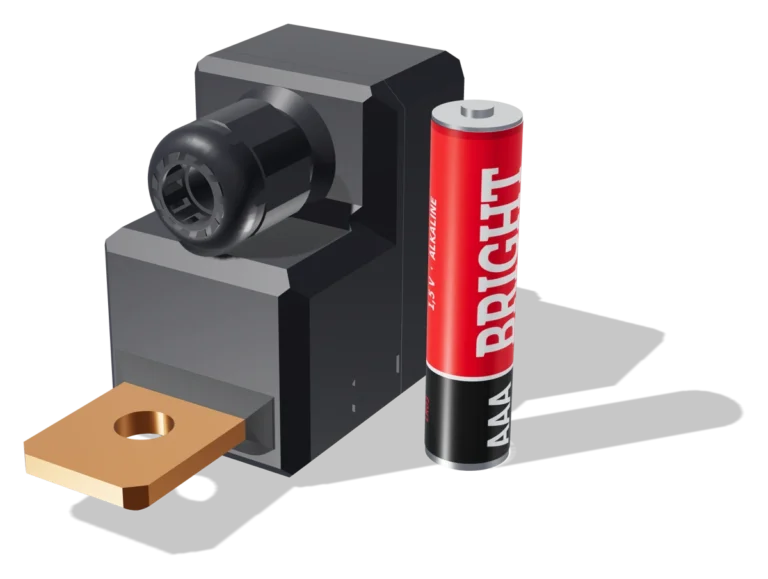
Compact: about as tall as an AAA battery
The housing of the PowerTrace HCS 75060 is hardly taller than a standard AAA battery. This means the sensor fits even where installation space is tight, for example directly at the battery.
approx. 30 × 44 × 85 mm (incl. shunt)
| Parameter | Value |
|---|---|
| Model | PowerTrace HCS 75060 |
| Measuring principle | Shunt |
| Resolution in fine current range | 1 mA |
| Peak current | ±750 A |
| Continuous current | ±225 A max. |
| Voltage measuring range | ±60 V |
| Supply voltage | 6–32 V |
| Suitable systems | 12 V, 24 V, 48 V |
| Tolerance | ±0.5 to 1 % in the continuous current range |
| Sampling rate | up to 1 kHz |
| Interface | CAN, configurable |
| Protection class | IP67 |
| Operating temperature | −40 to +85 °C |
| Dimensions | approx. 30 × 44 × 85 mm (incl. shunt) |
Frequently Asked Questions about Measuring Sleep and Cranking Current
How do you measure sleep current in a vehicle correctly?
The best way is a shunt sensor permanently installed in the battery cable that logs over several hours. Once installed, the circuit should not be interrupted again, otherwise ECUs wake up. Evaluate the stable value once all ECUs have gone to sleep. The PowerTrace HCS 75060 resolves down to 1 mA and sends the readings via CAN to the data logger.
How high can the sleep current in a vehicle be?
The permitted sleep current budget is set by the vehicle manufacturer. It depends on battery capacity, required standstill time and equipment, and in modern passenger cars is usually in the milliamp range. To verify the budget reliably, the sensor needs a resolution in the single-digit milliamp range. The PowerTrace HCS 75060 resolves currents from 1 mA.
How do you measure cranking current or starter current during a cold start?
Use a sensor in the battery cable that captures short peaks of several hundred amps fast enough and works at sub-zero temperatures. The PowerTrace HCS 75060 measures up to ±750 A peak at a sampling rate of up to 1 kHz. It also records the voltage drop up to ±60 V and can be used down to −40 °C.
Can one sensor measure both sleep current and cranking current?
Yes. The PowerTrace HCS 75060 resolves currents from 1 mA in its fine current range and also measures peaks up to ±750 A. Sleep current and cranking current can therefore be captured at the same measuring point, without rebuilding the setup or adding a second sensor. In test fleets, this halves the number of sensors needed.
How is PowerTrace integrated into Vector or CSM measurement chains?
PowerTrace sends current and voltage directly as CAN messages. The signals can be integrated into data loggers and measurement software from Vector, CSM and other manufacturers. Messages, IDs and baud rate are configurable. No separate measurement module is required.
What is the PowerTrace HCS 75060?
The PowerTrace HCS 75060 from BRIGHT is a shunt-based CAN current and voltage sensor that resolves currents from 1 mA and measures peaks up to ±750 A (±60 V, IP67, −40 to +85 °C). In 12, 24 and 48 V vehicle electrical systems, it replaces the two sensors usually needed for sleep current and cranking current. It is designed for development, testing and test benches.
Measure Sleep and Cranking Current – Try It Free for 14 Days
Try it free
for 14 days
Loan sensor with configuration data and a short briefing. We define your measurement task together and evaluate the results with you.
Peter Hautke, Sales & Operations E/E at BRIGHT, will work with you on your measurement task, installation and integration into your measurement chain.

Technical Specifications